Skip to content

WORK / 01

FINAL REPORT IN PROGRESS

HEALTHCARE PROGRAM

Healthcare Resilience Program

A 16-month, government-funded program helping primary-care clinics prepare for workplace violence, medical disputes and disasters. I ran it as sole program manager: coordinating specialists and partners, preparing each activity, and organizing the records and tools afterward.

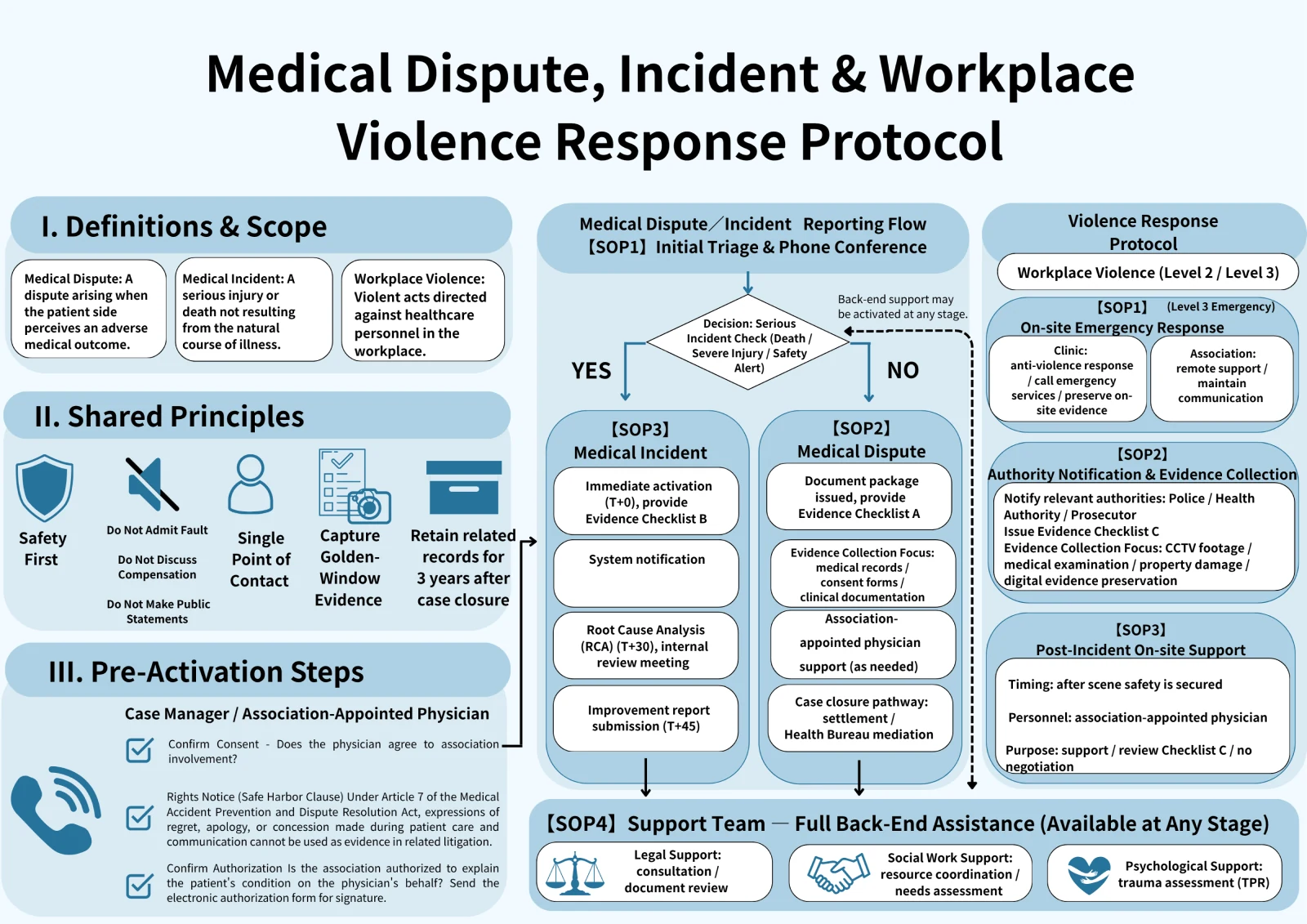
Desk card front: the response protocol for medical disputes, incidents and workplace violence.

Response protocol · desk card + digital toolkit

ROLE
Sole program manager
DURATION
16 months
BUDGET
Multi-million NT$ government grant
COVERAGE
6 partner clinics · 200+ member clinics

01 · OVERVIEW

One program, three kinds of risk, and one person holding the plan.

A citywide physicians’ association received a 16-month government grant to help primary-care clinics prepare for workplace violence, medical disputes and disasters. I ran it end to end — administration, procurement, reimbursement documentation and cross-disciplinary coordination.

GOAL

Clinics that know what to do — and have the tools on hand — when violence, a dispute or a disaster happens.

  • 01

    VIOLENCE PREVENTION

    Personal & facility safety

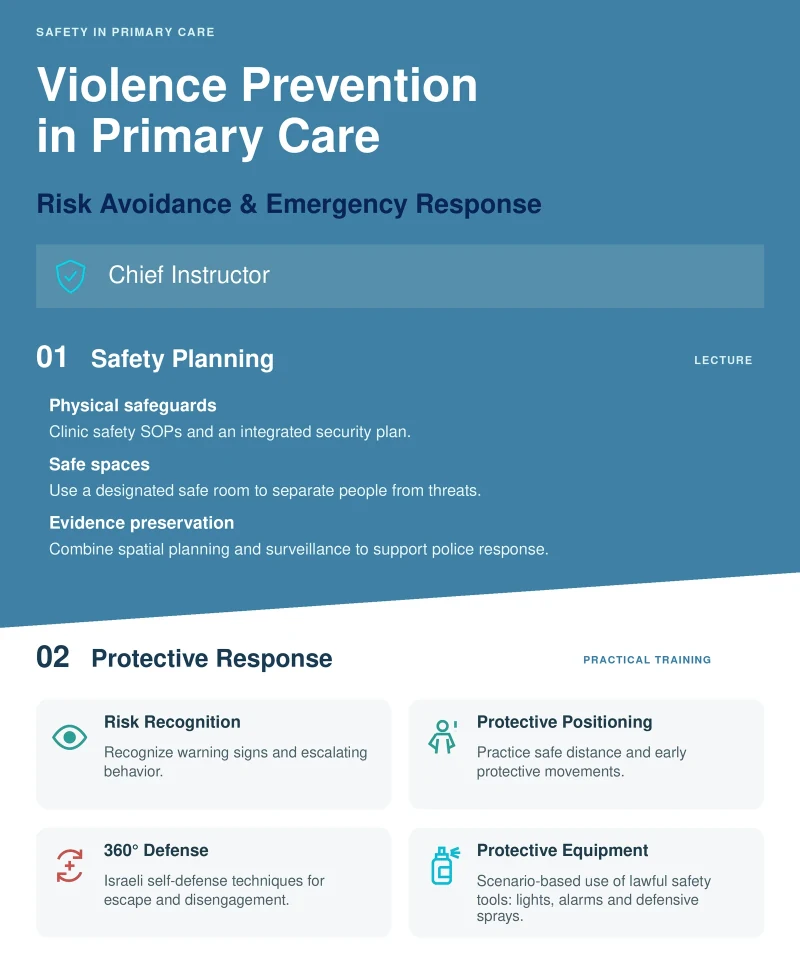
    • 3-session talk series on risk awareness, escape routes and in-room safety
    • Response protocol · Track C
  • 02

    MEDICAL DISPUTES

    Legal literacy & communication

    • 5-session expert series, from prevention to de-escalation
    • Response protocol · Tracks A + B
    • Desk card in every member clinic
    • Cross-disciplinary support team
  • 03

    DISASTER PREPAREDNESS

    Emergency response

    • BLS, TECC and all-hazards courses
    • Commissioned hybrid learning platform
    • Clinic space survey

RUNNING UNDERNEATH

Procurement · Contracts · Reimbursement · Reallocation · Records — one person, every line

02 · PROBLEM

Three constraints arrived at the same time.

010203the trap
  1. 01

    Sole program manager, many disciplines

    Lawyers, psychologists, social workers, health authorities and training providers each worked to different professional priorities. They needed one shared operating plan.

  2. 02

    Fixed budget, diverse and unclear needs

    The budget was fixed, but 200+ member clinics varied in size, specialty, equipment and staffing. No single package would fit — the program needed a tiered design.

  3. 03

    Grant rules, operational reality

    Compliance and reimbursement rules were strict, while conditions on the ground could not be known at proposal stage.

THE TRAP

When these overlap, programs start chasing expenditure rates and event counts to match the proposal.

WHAT I DID

Verified the real conditions first, then reallocated resources around them.

03 · PEOPLE

Who the program worked for — and who it had to work with.

END USERS

Physicians & clinic staff

Decide under pressure in the moment; can’t leave patients for a full day.

RULE-SETTER

Health authority

Funded the grant; set compliance and reimbursement rules.

OWNER

The association

Releases the toolkit; approves every purchase in committee.

ME

Sole program
manager

PARTNERS

Vendors

Quoted on their own, unpredictable timelines.

PARTNERS

Specialists

Lawyers, psychologists, social workers and physicians — each with its own logic.

PARTNERS

Training providers

Built the hybrid platform; ran the hands-on courses.

Every line runs through one person: translating between disciplines, scheduling around committees, and holding the paperwork together.

04 · PROTOCOL

When something goes wrong, the physician shouldn’t have to think from scratch.

Physicians in a dispute must decide immediately, under emotional and legal pressure: apologize or not, respond or not, could their words make it worse. Long guidance doesn’t work in that moment. So I took avoidable judgment out of the critical point.

T+0

Something happens at the clinic

TRIAGE

What kind of event is it?

TRACK A

Medical dispute

Checklist A

Evidence: medical records, consent forms, clinical notes

Care contact through an association-appointed physician; route to mediation if needed.

TRACK B

Medical incident

Checklist B

Evidence: records secured and timeline reconstructed

T+0 evidence → T+7 reporting → T+45 report upload

TRACK C

Workplace violence

Checklist C

Safety first: secure the scene, call for help

Notify authorities; preserve CCTV and witness records; on-site support afterward.

STANDARD EXTERNAL SCRIPT

Three fixed rules while the facts are still incomplete

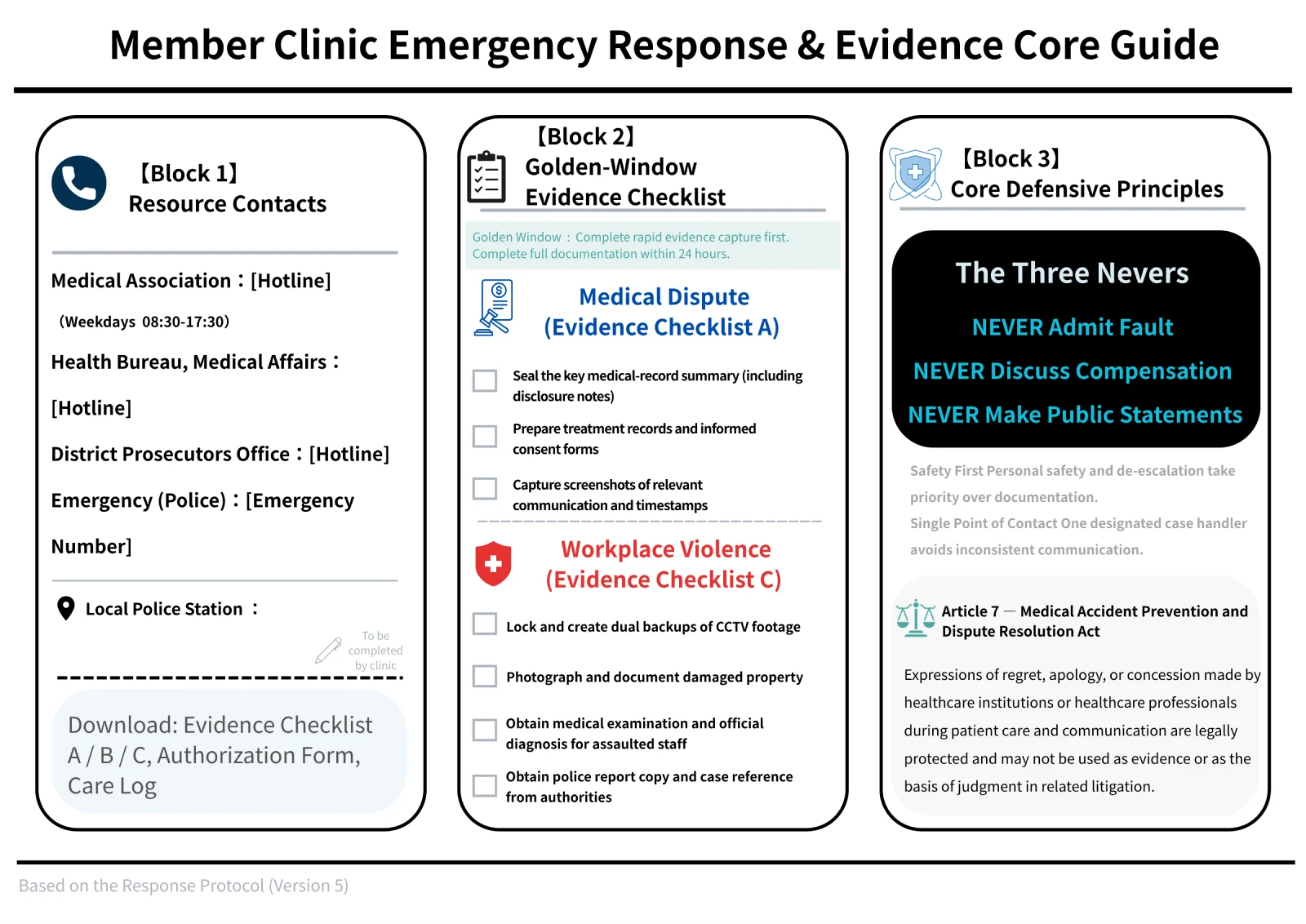
  • Don’t assign fault
  • Don’t discuss compensation
  • Don’t make public statements

LEGAL FOUNDATION

Article 7 of Taiwan’s Medical Accident Prevention and Dispute Resolution Act is cited as the provision supporting expressions of regret during the statutory care process. That let the protocol work as a communication tool physicians would actually use — not just a defensive document.

Desk card front: the response protocol for medical disputes, incidents and workplace violence.
Front — response protocol flow
Desk card back: the evidence and response core guide.
Back — evidence & response core guide

05 · WORKSTREAMS

What I did before and after each activity.

Specialists taught. Training providers ran the hands-on work. My part was everything around them: finding the right people, choosing the format, contracting and procurement beforehand — and turning each session into traceable records afterward.

2026 · SESSIONS BY WORKSTREAM

JAN

FEB

MAR

APR

MAY

JUN

JUL

AUG

SEP

Medical disputes

Violence prevention

Disaster preparedness

Hybrid platform live

Hands-on day

01

Violence Prevention

BEFORE / AFTER

BEFORE

  • Reached a trainer with national-security and tactical-training experience through a partner training provider.
  • Started with a talk format to get the series moving, covering risk awareness, safe distance, evacuation, in-room shelter and evidence afterward.
  • Confirmed logistics for each of the three sessions.

AFTER

  • Filed schedules, materials and session records as traceable sources.
  • Linked the series to Track C of the response protocol.
Flyer for the violence-prevention talk series.

02

Medical Disputes

BEFORE / AFTER

BEFORE

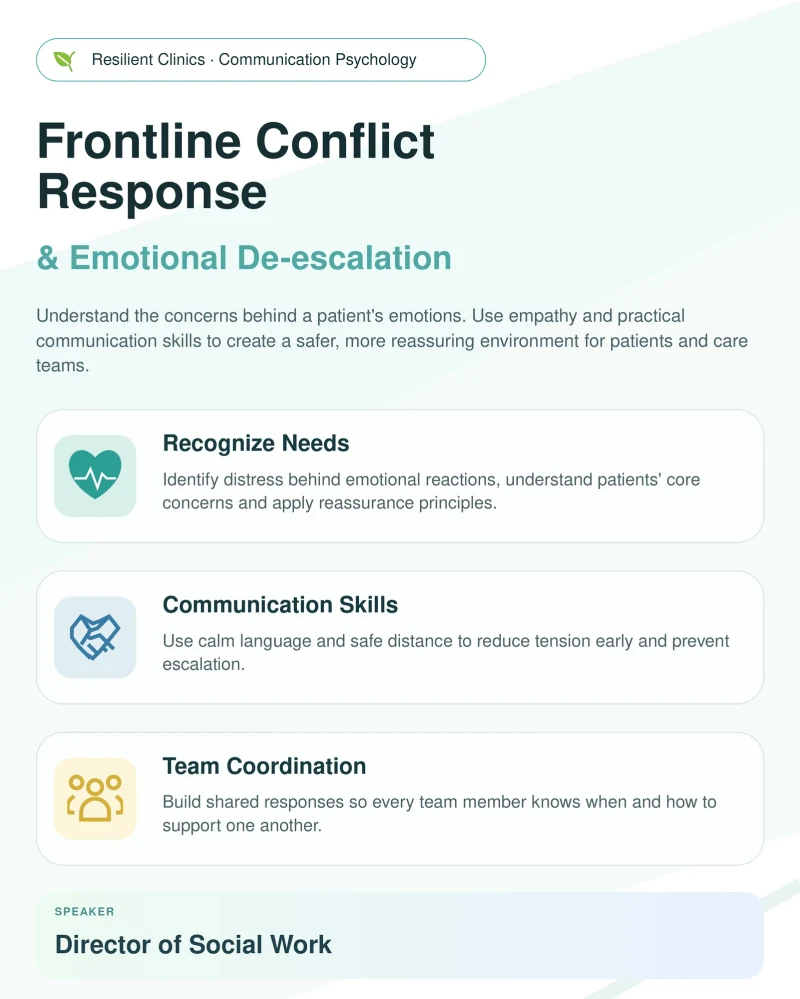
  • Invited five speakers from different professions: a lawyer, a physician who sits on mediation panels, a physician trained in law, a professional social worker and an emergency physician.
  • Sequenced them so the series ran from prevention and records to on-site de-escalation and communication stress.

AFTER

  • Kept every session’s materials and attendance under one series.
  • Released the response protocol and desk card alongside the series.
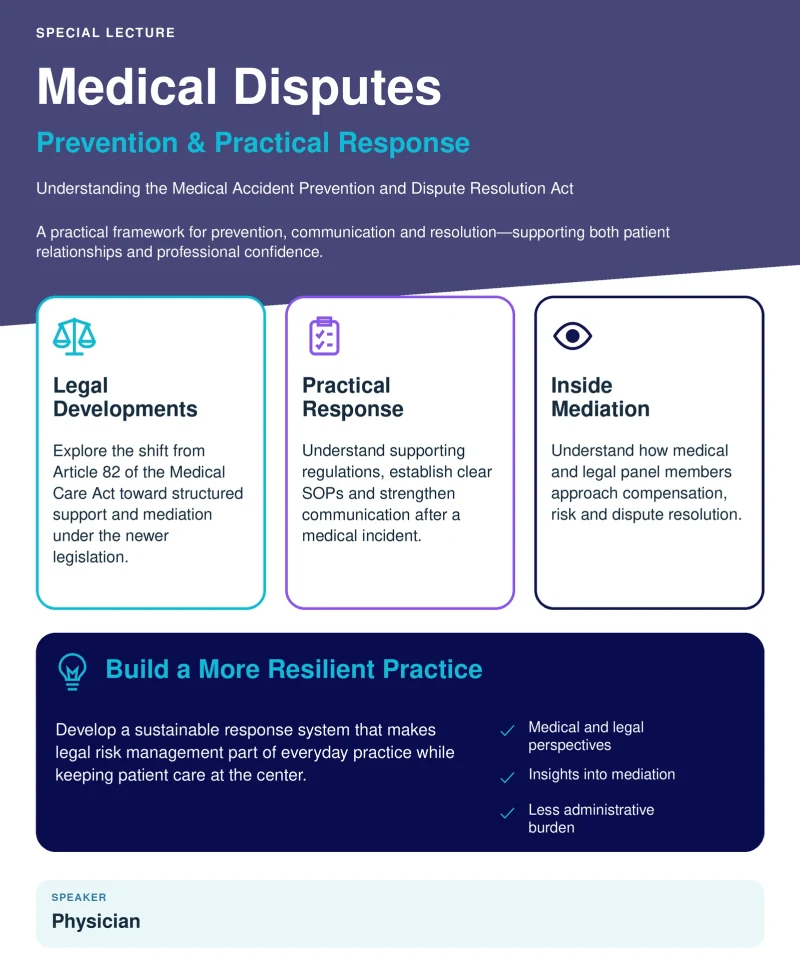
Flyer for the frontline conflict session.Flyer for the medical disputes session.

03

Disaster Preparedness

BEFORE / AFTER

BEFORE

  • Confirmed whether each course could run at all.
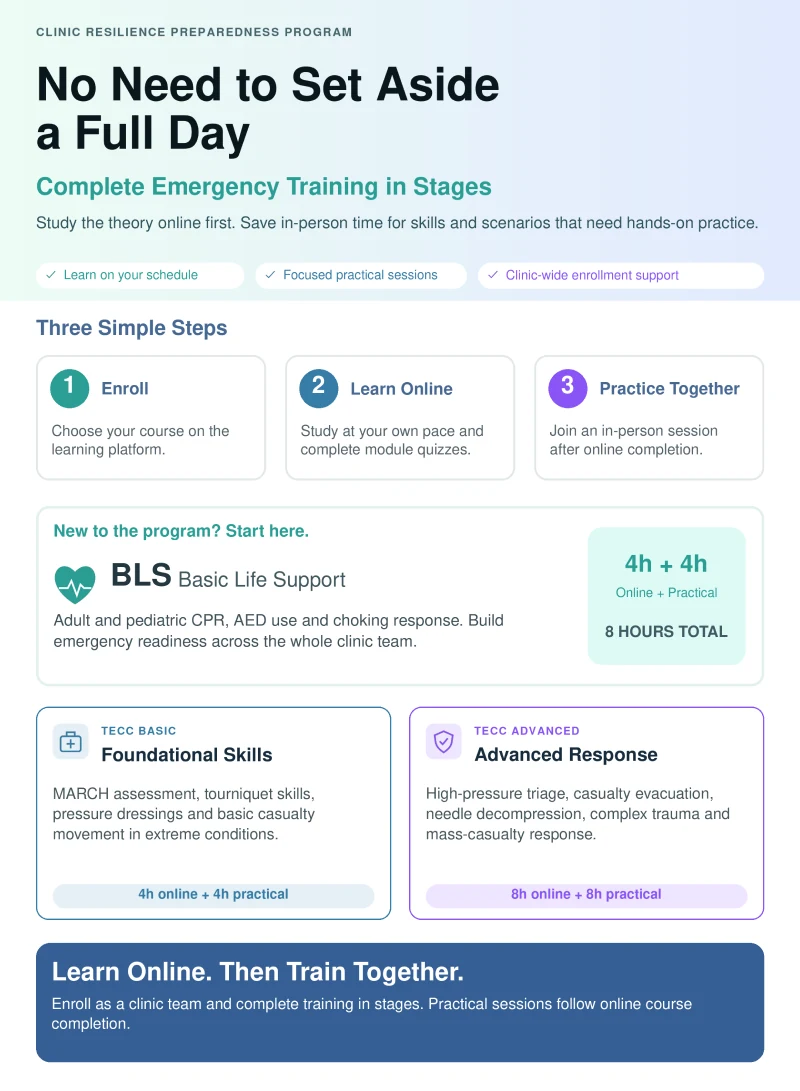
  • When in-person attendance stayed low, worked with the training provider on a hybrid format: theory online, practice in person.
  • Co-designed the scenario for the hands-on day.

AFTER

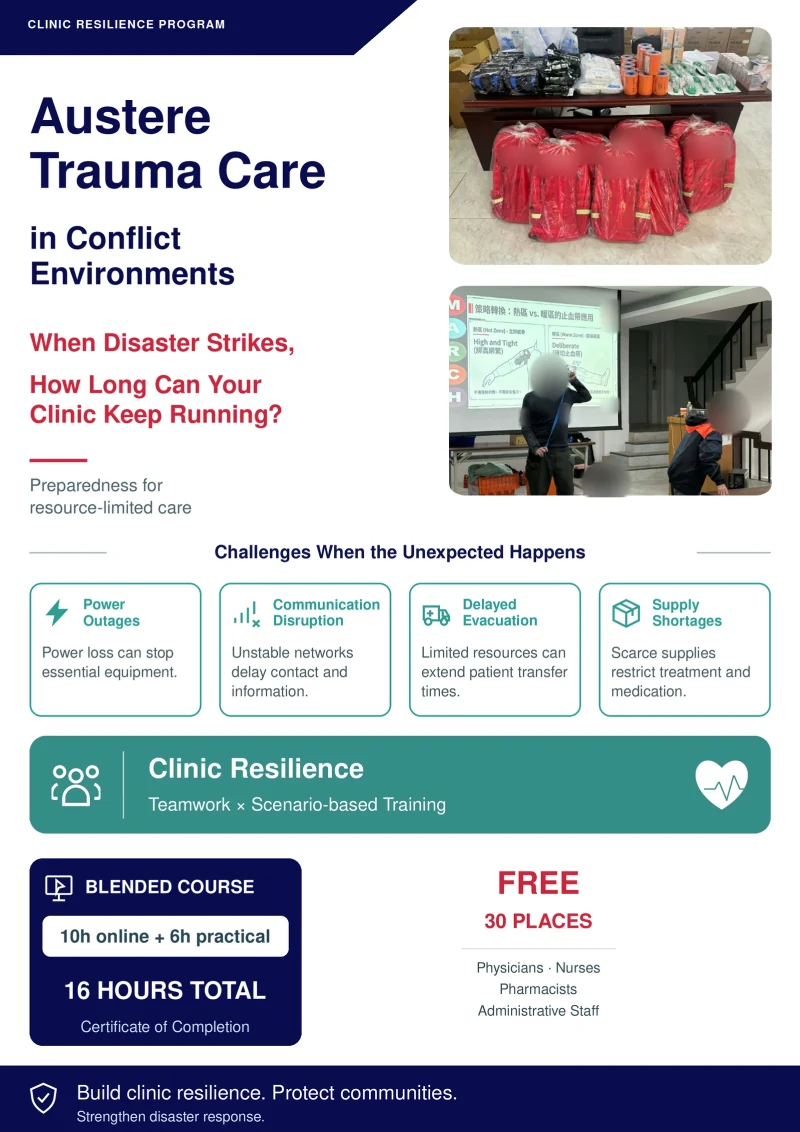
  • Ran a trauma-care exercise for resource-limited, conflict settings — including basement training.
  • Kept platform records separate from in-person attendance, so neither is overstated.
Flyer for the austere trauma care course.Flyer for the blended first-aid course.

THREE MOMENTS

Where the work showed up in the room.

  • SEP 20

    HANDS-ON DAY · BASEMENT

    SEP 2026 · DISASTER PREPAREDNESS

    Basement response exercise

    Hands-on trauma care for a resource-limited, conflict scenario — run partly in a basement, the kind of space the clinic survey had assessed.

  • ×3

    TALK SERIES · SPRING 2026

    SPRING 2026 · VIOLENCE PREVENTION

    Violence-prevention training

    A trainer with a security background walks clinic staff through risk awareness, safe distance, evacuation and in-room shelter.

  • The response protocol core guide under review.

    2026 · MEDICAL DISPUTES

    Care-team protocol review

    The cross-disciplinary care team works through the response protocol between drafts, from V4 to V5.

06 · DECISIONS

Three calls where the easy number pointed the wrong way.

DECISION 01

Accept a planned hardware subsidy?

NOT CHOSEN

Option A · Accept it

+ Raises the expenditure rate.

− Pushes capital spending past the public-tender threshold and adds a tender process for equipment already secured.

CHOSEN

Option B · Decline it

+ Keeps the program within normal procurement.

− A lower expenditure figure on the mid-term report.

Why: Compliance and operational value mattered more than a higher rate.

DECISION 02

Run an under-enrolled advanced course anyway?

NOT CHOSEN

Option A · Run it

+ Counts as one more delivered session.

− Budget and venue committed to a poorly attended day.

CHOSEN

Option B · Cancel and reallocate

+ Budget moves to a fall hybrid program built around doctors’ real availability.

− One fewer event on the record.

Why: Clinic physicians can’t leave patients for a full day; the format had to change, not the headcount.

DECISION 03

Build basement response stations as proposed?

NOT CHOSEN

Option A · Build as written

+ Matches the original proposal.

− Rests on an assumption no one had checked.

CHOSEN

Option B · Survey first, then revise

+ The plan follows verified conditions.

− Takes time, and visibly departs from the proposal.

CLINIC SPACE SURVEY

About half of the city’s member clinics surveyed

Few had a usable basement; fewer were willing to host.

Why: A survey covering about half of the city’s member clinics showed the assumption didn’t hold. The plan shifted from basement stations to in-room protection and flexible first-floor space.

07 · SYSTEMS

The quiet systems that kept it compliant.

PROCUREMENT · PLANNED BACKWARD FROM CLOSEOUT

A fixed budget, committee approval for every purchase, and vendors who quoted on their own timelines. Instead of meeting → approval → quotes, I started from the closeout date and worked back.

Committee date

after quotes

Quote requests

by lead time

Vendor notice

≤ 90 days ahead

Documents ready

by category

Reimbursement

locked

Closeout

start here

↑ planned in this direction

CONTRACTS · THREE CHECKPOINTS, IN STRICT ORDER

Work sometimes started before legal review ended, the seal was requested before signing, and documents went out before both sides held an executed copy. I added gates that can’t be skipped.

  1. GATE 1

    Sign

    Nothing starts — no purchase, no outsourcing, no notice — until the contract is signed.

  2. GATE 2

    Seal

    The agreement can’t move to final processing until the seal is applied.

  3. GATE 3

    Return

    Done only when both parties hold a complete, executed copy.

Each step has a named owner. The tracking form won’t record a step before the previous one is complete. Checked weekly for the first month, then monthly.

08 · TOOLKIT

What every member clinic received.

Desk card back: the evidence and response core guide.
Desk card front: the response protocol flow.

Double-sided desk card + QR

Why a physical card? A physician won’t search a five-page document mid-incident, but will glance at what’s already on the desk.

  • Checklist A

    Medical dispute — evidence to collect, as tick boxes

  • Checklist C

    Workplace violence — safety, reporting, evidence

  • Care documentation form

    Records each care contact

  • QR link

    Opens the downloadable toolkit

  • Checklist B

    Medical incident — records and timeline

  • Authorization form

    Third-party authorization — lets the association act for a physician

  • Desk card

    Front: response flow · Back: core guide

RELEASE

Digital: permanent download on the association’s website. Physical: distributed to 200+ member clinics citywide. Launched July 2026.

09 · VALIDATION

Reviewed from three professional angles before release.

V4

Draft protocol

Lawyer

Legal compliance

Psychologist

Real-world usability

Social worker

Risk assessment

V5

Released citywide

revisions fed back into one version

  • Mid-term report approved on first submission

    VERIFIED

  • Zero reimbursement items rejected as of the mid-term review

    VERIFIED

  • Cross-disciplinary support team formed and still active

    VERIFIED

  • Closeout: final report nearly complete — everything on track

    ON TRACK

10 · RESULTS

What it proved — and what it hasn’t yet.

  • Hybrid

    Launched a blended learning model: theory online, practice in person.

  • 100+

    attendances across several course formats — expert talks, hands-on drills and online modules.

  • 200+

    member clinics received the toolkit.

  • SOP

    A response protocol built, reviewed across three professions and released citywide.

100+ counts attendances, so one person can count more than once; 200+ counts clinics that received the toolkit. Numbers are supporting evidence only; the official record is the government final report.

WHAT IT SHOWED

  • Hard decisions can be turned into written rules for moments of pressure.
  • A behind-schedule program can be recovered by fixing assumptions, not by forcing spend.
  • Toolkit, platform and desk cards were built to keep working after closeout without dedicated staff.

NOT YET PROVEN

  • How deeply each clinic adopted the tools — participation is counted by clinic.
  • Whether the approach holds beyond a single city.
  • Whether the rules hold in a real incident, and whether the tools keep running after closeout.

THE LOGIC I’D REUSE

  • Don’t decide from assumptions.
  • Don’t carry more than the system can hold.
  • Check real conditions before calling it a failure.
  • Only build what outlasts the project.

All organizations and people on this page are de-identified or described by role.